



Scientific Applications:
LeanMD - Protein Folding on Peta-FLOP class machines
LeanMD is a molecular dynamics simulation application written in Charm++ and Structured Dagger for PetaFLOPs class supercomputers. It is being developed as the next generation of NAMD, one of the parallel applications winning the Gordon Bell Award in SC2002. NAMD, as a state-of-the-art parallel molecular dynamics application that is also written in Charm++, has already been proven to be able to scale to 3000 processors. However, it is not ready for next generation parallel machines with hundreds of thousands, or even millions, of processors due to the limited parallelism exploited in the application. Clearly, it requires a new parallelization strategy that can break up the problem in a more fine-grained manner to effectively distribute work across the extremely large number of processors.

In NAMD, the atoms in the simulation are divided spatially into cells roughly the size of the cutoff distance. Local interactions are calculated each timestep between only the nearest neighbor cells (`one-away' interactions).This ensures that all atoms within the cutoff radius are calculated. However, this strategy produces a division that is coarsely grained for planned machines such as Blue Gene/C. For example, with a cutoff radius of 15 Å, a 150 x 150 x 150 Å simulation space would give only 1,000 cells and 13,000 cell-to-cell interactions to calculate. Considering that the Blue Gene/L machine is approximately 64,000 nodes, the division would leave nodes idle, even if interactions were delegated to a single node.
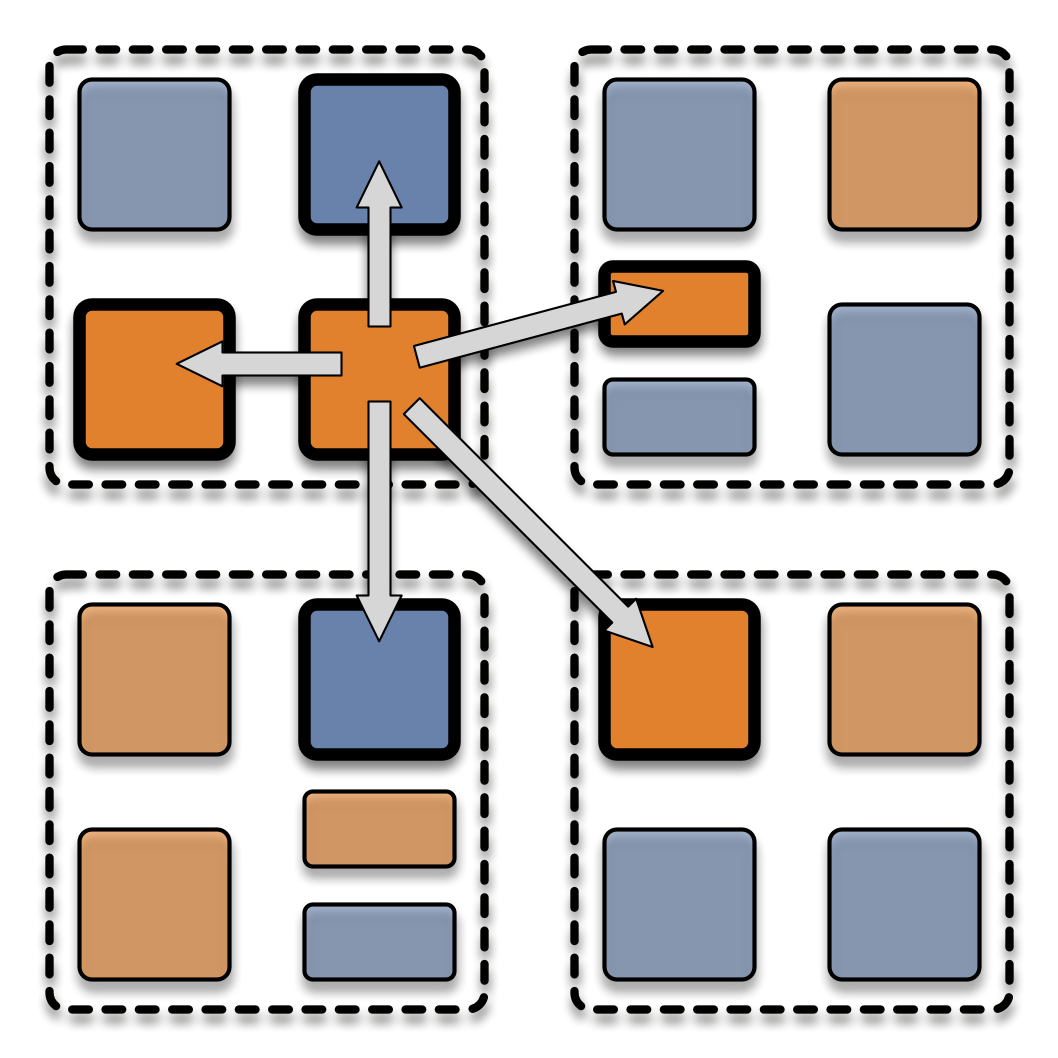
To address the issue of creating finer-grained parallelism for cutoff interactions, LeanMD is being developed as an experimental code. In LeanMD, the `one-away' strategy is replaced with a `k-away' strategy. Instead of one cell representing the cutoff distance, in LeanMD three cells would span the cutoff distance as shown in the picture. Therefore, in order to do the cutoff calculation, a cell must compute its interactions with every cell that is "three-away'' in this scenario. Given the simulation example above, a three-away strategy would produce 27,000 cells and more than 4 million cell-to-cell interactions, a number of objects that is easily distributed across the 64,000 nodes of the Blue Gene/L.
LeanMD uses the PINY MD physics engine for its molecular dynamics calculations. This represents an ongoing collaboration with Mark Tuckerman (NYU) and Glenn Martyna (IBM TJ Watson) for molecular simulation. We anticipate merging LeanMD with leanCP to create a unified simulation environment where areas of interest can be modelled by QM methods within a larger classical framework.
LeanMD (a full-fledged charm++ code) as a real benchmark, has been run on our Blue Gene/L simulator on Lemieux. The predicted speedup and generated simulation data can be seen in the paper.
This work is funded by National Science Foundation grant ITR 0121357
In NAMD, the atoms in the simulation are divided spatially into cells roughly the size of the cutoff distance. Local interactions are calculated each timestep between only the nearest neighbor cells (`one-away' interactions).This ensures that all atoms within the cutoff radius are calculated. However, this strategy produces a division that is coarsely grained for planned machines such as Blue Gene/C. For example, with a cutoff radius of 15 Å, a 150 x 150 x 150 Å simulation space would give only 1,000 cells and 13,000 cell-to-cell interactions to calculate. Considering that the Blue Gene/L machine is approximately 64,000 nodes, the division would leave nodes idle, even if interactions were delegated to a single node.
To address the issue of creating finer-grained parallelism for cutoff interactions, LeanMD is being developed as an experimental code. In LeanMD, the `one-away' strategy is replaced with a `k-away' strategy. Instead of one cell representing the cutoff distance, in LeanMD three cells would span the cutoff distance as shown in the picture. Therefore, in order to do the cutoff calculation, a cell must compute its interactions with every cell that is "three-away'' in this scenario. Given the simulation example above, a three-away strategy would produce 27,000 cells and more than 4 million cell-to-cell interactions, a number of objects that is easily distributed across the 64,000 nodes of the Blue Gene/L.
LeanMD uses the PINY MD physics engine for its molecular dynamics calculations. This represents an ongoing collaboration with Mark Tuckerman (NYU) and Glenn Martyna (IBM TJ Watson) for molecular simulation. We anticipate merging LeanMD with leanCP to create a unified simulation environment where areas of interest can be modelled by QM methods within a larger classical framework.
LeanMD (a full-fledged charm++ code) as a real benchmark, has been run on our Blue Gene/L simulator on Lemieux. The predicted speedup and generated simulation data can be seen in the paper.
This work is funded by National Science Foundation grant ITR 0121357
People
Papers/Talks
04-11
2004
[MS Thesis]
[MS Thesis]
LeanMD: A Charm++ Framework for High Performance Molecular Dynamics Simulation on Large Parallel Machines [Thesis 2004]
03-05
2004
[Paper]
[Paper]
BigSim: A Parallel Simulator for Performance Prediction of Extremely Large Parallel Machines [IPDPS 2004]
02-03
2002
[Paper]
[Paper]
A Parallel-Object Programming Model for Petaflops Machines and Blue Gene/Cyclops [NSFNGS 2002]